
What does American music sound like?
There’s likely no single answer. It can be bold and brassy, deeply lyrical, unmistakably familiar, or entirely unexpected. In American Icons, three composers offer three distinct answers to that question.
George Gershwin, Samuel Barber, and Aaron Copland each helped shape the sound of American classical music in the 20th century. They drew inspiration from different places and created musical voices entirely their own. Together, their works move from the wit and theatrical energy of Broadway to the intimacy of Barber’s Violin Concerto and the sweeping scale of Copland’s Third Symphony.
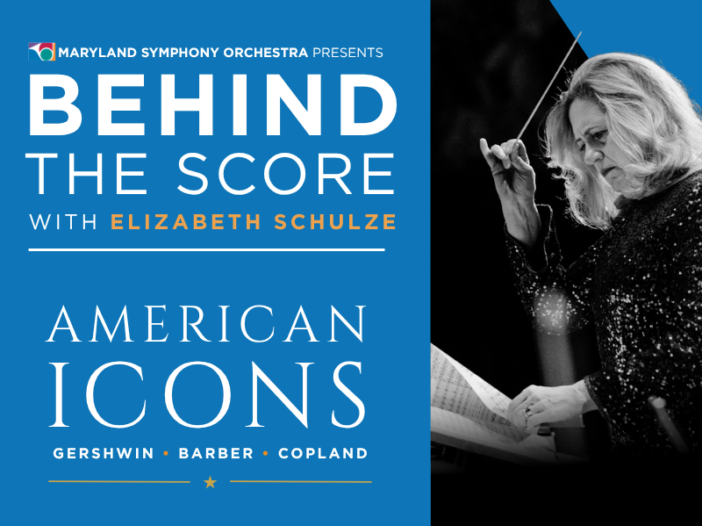
Ahead of the MSO’s season-opening concert, we sat down with Music Director Elizabeth Schulze to go behind the score. She shares what connects these three American voices, what to listen for throughout the evening, and why this music continues to resonate today.
What made Gershwin, Barber, and Copland the right composers to tell the story of American Icons?
Elizabeth Schulze: Each of these composers belongs to what has been called America’s greatest generation. All three works on our program were written during a time of struggle and ultimate triumph in our country’s history, from the Great Depression through the end of World War II. The arts in America were essential during that time. People relied on them to lift sagging spirits, express hope, promote common cause, and honor perseverance and patriotism.
When you think about an “American sound” in classical music, what does that mean? Is there something audiences can listen for across these three very different composers?
Elizabeth: Each of these composers was a master of melody and song. Their clear-headed approach to lyrical expression was devoid of sentimentality but full of deeply felt, honest sentiment. There is always something attractive, virtuosic, and confident in their music, but they wear their considerable mastery lightly, with humor and sincerity. All three received Pulitzer Prizes for their work, a national stamp of approval.
We open with Gershwin’s Of Thee I Sing Overture, which comes from a political satire. What made this the right way to open the program, and what should audiences know about its sense of humor?
Elizabeth: Folks experiencing the Great Depression were looking for release during a time of extreme financial stress and lots of political finger-pointing. Of Thee I Sing was inspired by the popular British operettas of Gilbert and Sullivan, which got away with all sorts of social commentary and criticism hidden behind humor and lighthearted satire. George and Ira Gershwin’s jazzy music and smart lyrics combined just the right amount of absurdity and fun with catchy, exuberant melodies that kept audiences laughing during a long run on Broadway.
Barber’s Violin Concerto feels like a very different musical world from Gershwin. What do you love about this concerto, and what makes it such a special showcase for the violin?
Elizabeth: Barber’s musical world was miles away from Gershwin’s. Gershwin grew up musically in Tin Pan Alley and found his way to classical music gradually.
Barber was a child prodigy, immersed in classical music and composing piano works by the time he was seven years old. He was championed by the great conductor Toscanini and other classical luminaries while still in his twenties. It took some time for Barber to find his voice (and he had a beautiful baritone singing voice besides), but once he did, audiences fell in love with his ability to blend exquisite Romantic lyricism with well-balanced and judicious moments of neoclassical modernity. It was a tightrope act, but he pulled it off beautifully. In his concerto, the violin becomes a romantic hero in the first movement, a poet-troubadour in the second, and an acrobat in the third.
The finale of Barber’s concerto has a completely different energy from the first two movements. What happens musically in those final few minutes?
Elizabeth: The last movement was composed as a “perpetual motion,” with the violinist playing scurrying, quick notes nonstop and the orchestra breathlessly trying to keep up! This is “shredding” at its finest!
Copland’s Third Symphony is enormous in both scale and sound. What story or journey do you hear unfolding across the symphony?
Elizabeth: Copland composed his famous Fanfare for the Common Man in 1942. It was not yet the iconic work it would become, so he used it as building material for the finale of his Third Symphony a few years later. The massive lift of those rising notes lends itself to an epic story of the resilient American spirit.
I hear a story of E pluribus unum in this work. In the first movement, singular strands of melody combine and recombine in call and response, creating a feeling of communion. The second movement is a declaration of strength and exuberance. The third movement has some of the most heart-wrenching moments, certainly a reflection of war and its darkness. But the music moves into the light and an exultant finale. The clouds fall away, and we hear the Fanfare in all its glory and power.
These works were written within roughly 15 years of one another, during a particularly complicated period in American history. Do you hear that time and place reflected in the music?
Elizabeth: Each work was written for a different situation, but each seeks to connect directly with its audience emotionally, whether to entertain, soothe, or enlighten. All of these works carry confidence and conviction in every note on the page.
As a conductor, is there a moment in this program that you’re especially excited to experience with the orchestra?
Elizabeth: I love each of these works: the exuberant and jazzy mastery of Gershwin, the lush romanticism of Barber, and the powerful, plainspoken honesty and grandeur of Copland.
For someone hearing one or all three of these works for the first time, what’s one thing you’d tell them to listen for, or simply allow themselves to experience?
Elizabeth: I hope you will hear why these works have become iconic examples of American music and revered expressions of the American spirit. Listen for exuberant and singable melodies, reflective and poignant lyricism, and confident, masterful musical forms that build and inspire.
Experience these works together as the MSO opens its season with American Icons. Whether you know every note or are hearing them for the first time, Elizabeth and the orchestra invite you to discover what each composer brings to the American story.
Tickets are available at tickets.marylandsymphony.org or by calling (301) 797-4000.