
How do you tell a story without saying a word?
Shakespeare gave his characters plenty to say. But their feelings—like the excitement of falling in love, the weight of suspicion, the thrill of mischief—can take on a life of their own through music.
In Shakespeare in Symphony, four composers approach four very different worlds: the troubled court of Hamlet, the royal pageantry of Henry V, the enchanted confusion of A Midsummer Night’s Dream, and the love and conflict of Romeo and Juliet. Together, they offer a chance to hear familiar stories from a different perspective.
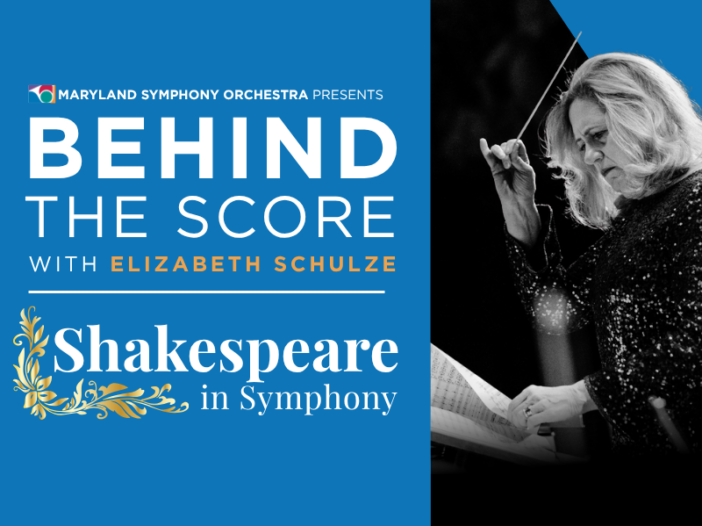
Ahead of the Maryland Symphony Orchestra’s November 14 and 15 performances, Music Director Elizabeth Schulze takes us behind the score to explore what drew these composers to Shakespeare, how an orchestra brings his characters to life, and what to listen for along the way.
What drew you to this program? What interested you about bringing these four Shakespeare-inspired works together?
Elizabeth Schulze: I’ve been a fan of Shakespeare ever since my parents took me to my first play, “As You Like It,” at the Shakespeare Festival in Stratford, Ontario, Canada. I was immediately taken by the musicality of his poetry. Shakespeare has fascinated writers, actors, artists, composers and audiences for centuries. Many of our greatest composers have created operas, incidental music and even musical theater works that retell Shakespeare’s stories. I’ve been eager for the MSO to revisit Prokofiev’s Romeo and Juliet ballet music, so that was always going to be the core of the program. And because that is such a masterful and popular work, I wanted to surround it with other Shakespeare-inspired works, some familiar and some not so well known.
Shakespeare’s plays have inspired composers for centuries. What do you think makes his stories such a rich starting point for music?
Elizabeth: It starts with his poetry. The language of the plays is always musical. It engages the ear, challenges, entices and delights. His stories seem universal and often have their roots in more ancient stories. Even the historical plays have that epic quality that can take you right to the battlefield or into the mind of a king or a general.
For someone who hasn’t read these plays, what would be helpful to know before listening? How much of the story do we need to bring with us?
Elizabeth: Most of our composers enter into the plot of the play through musical characterization. Even if you don’t know the story, the music vividly depicts the main characters by tying them to musical themes that evoke their particular personality traits or tell their dramatic story arcs and inner lives.
We begin with Tchaikovsky’s Hamlet. This is a story full of grief, suspicion, and difficult choices. How does Tchaikovsky bring us into that world, and what should we listen for in the overture?
Elizabeth: Tchaikovsky was engaged to write several short works of incidental music to be performed between the acts or important scenes of the play. This music was intended to support the drama by setting the mood, while not replacing the action or words. When those plans fell through, he fashioned a Fantasy-Overture from the musical fragments he had prepared. The result was a wonderful mood piece that didn’t seek to tell the story outright, but rather dramatically evoke a dark, tragic atmosphere and the emotional states of the major characters. His depiction of the doomed Ophelia with a theme played by the oboe is especially successful.
Walton’s Henry V takes us into a very different setting. What gives this music its character, and where do you hear something more personal beneath the royal pageantry?
Elizabeth: First of all, it’s film music and therefore tied to specific images, characters and actions. But we will not be performing the actual film score. The conductor of the film, Muir Mathieson, worked with Walton to develop a suite for orchestra that refashioned and adapted the film music into longer episodes that were more suitable for the concert hall. Walton’s music was originally conceived, though he did reference a few 15th- and 16th-century drinking, battle and courting songs from Britain and France to evoke the period of the story.
Mendelssohn’s A Midsummer Night’s Dream brings a little mischief to the program. How does he suggest the magic, humor, and confusion of the play through the orchestra? Is there a particular musical detail you’d point out to listeners?
Elizabeth: The first miracle of this work is that it was written by a 17-year-old! But perhaps it is the youthfulness and energy and fantasy of the young Mendelssohn that guaranteed the perfection of his impression of Shakespeare’s perfect play. The music is perfectly balanced, with shimmering strings evoking the world of fairies. Bottom’s donkey brays provide humor, and the gentle love theme, courtly entrances and hunting calls all reference scenes within the play, but the overall musical structure hews less to the drama and more to the traditional sonata-allegro form established by Haydn, Mozart and Beethoven.
Prokofiev’s Romeo and Juliet is at the heart of this concert. What makes his telling of the story so compelling to you?
Elizabeth: I’ll never forget seeing a film of Rudolf Nureyev and Margot Fonteyn dancing this masterpiece by Prokofiev in a famous Royal Ballet production from 1966. Not only was I enamored of the dancers, but the music seemed to be creating the scene and telling the story in a most powerful way, impelling and inspiring the dancers, rather than simply supporting them or providing a musical backdrop. The music itself transformed the brilliant thirty- and forty-something dancers into the youths of the play, in all their innocence and passion.
In the selections we’ll hear from Romeo and Juliet, which characters or moments should audiences listen for? How does Prokofiev help us recognize the tenderness, tension, or conflict in a scene?
Elizabeth: I’ve selected excerpts from both orchestral suites, derived from the ballet music, that vividly display Prokofiev’s genius at characterization, but even more so, his ability to convey action, pageantry and passion that impels a listener to see as well as hear. The youthful innocence of Juliet, the terrible and fatal pride of the feuding families, the earnest passion of the young lovers and the desperate and vicious physicality of battle—all of this indelibly depicted by Prokofiev’s image-evoking music. He literally uses the orchestra like a box of paints.
These composers each have a distinct musical voice. As we move from one work to the next, what differences might listeners notice in the way they tell a story?
Elizabeth: Each of these composers sits firmly in their time stylistically. Tchaikovsky sets a mood, Walton evokes the past, Mendelssohn transcends tradition and Prokofiev paints a living picture in vivid dramatic strokes.
As a conductor, how does knowing the play influence the way you rehearse and perform the music? Do you talk with the musicians about characters and scenes, or approach those ideas in another way?
Elizabeth: The most important way into the music is understanding how the composer was influenced by Shakespeare’s works. Of course, it is essential for me to know as much as possible about the plots and characters too, but I get my cues from the composer and convey essential connections to my colleagues in the orchestra as necessary. For the most part, the composer has given the musician all the information they need in their part already.
Is there a moment in this program that you especially look forward to hearing come together? What makes it stand out for you?
Elizabeth: There is something mysterious that happens when two separate art forms encounter each other and combine. The theatrical expression of story and character meeting the abstraction of music results in something completely new, and yet the essence remains: Shakespeare revered but reimagined.
Experience these works together in Shakespeare in Symphony. Whether you know the plays by heart or are meeting these characters for the first time, Elizabeth and the orchestra invite you to discover how four composers bring Shakespeare’s stories to life through music.
Tickets are available at tickets.marylandsymphony.org or by calling (301) 797-4000.
Shakespeare in Symphony
The Maryland Symphony Orchestra at The Maryland Theatre
Saturday, November 14, 2026 | 7:30 PM
Sunday, November 15, 2026 | 3:00 PM
Elizabeth Schulze, Conductor
Pyotr Ilyich Tchaikovsky | Overture to Hamlet
William Walton | Suite from Henry V
Felix Mendelssohn | Overture to A Midsummer Night’s Dream
Sergei Prokofiev | Selections from Romeo and Juliet
Concert sponsored by the Robert & Marjorie Hobbs Family.